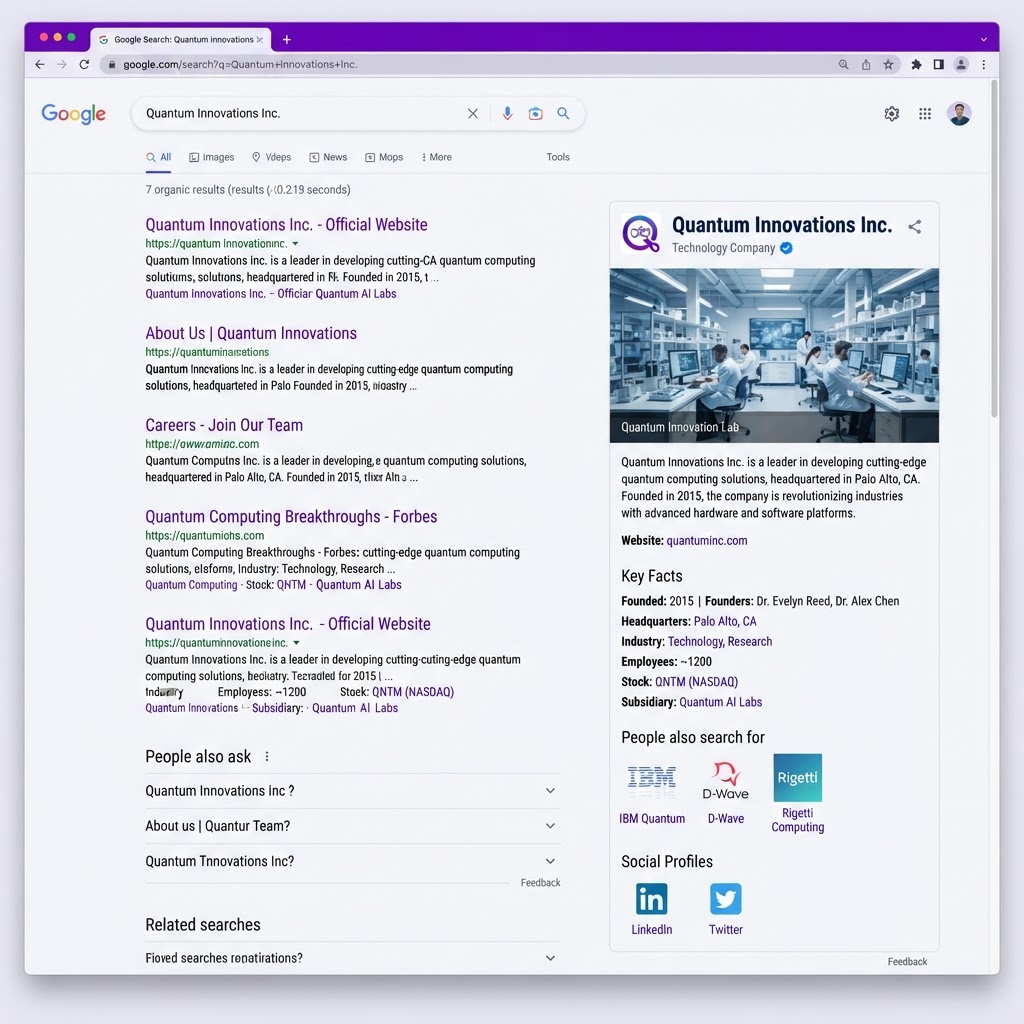
What Is a Google Knowledge Panel and How Do I Get One?
What is a Google Knowledge Panel? How Google decides who gets one, how to build the entity signals that trigger it, and how to claim and correct a panel once it appears.

Written by
Sam Allcock
— Founder, Digital24A Google Knowledge Panel is the information box that appears on the right of search results for recognised people, companies, and organisations - Google's summary of who you are, assembled from sources it trusts.
In this guide you'll learn how panels are generated, the entity-building work that makes one appear, how to claim and correct a panel, and the realistic timescales involved.
There's no application form and no guarantee - a panel is earned by becoming an unambiguous, well-documented entity in Google's knowledge systems - so it's a good idea to treat this as a programme measured in months, not a task measured in days.
Why does a Knowledge Panel matter?
For founders, executives, and companies, the panel is the first impression for anyone who searches your name - investors, journalists, customers, hires.
It signals establishment (Google itself vouching that you're a known entity), it anchors your search reputation alongside the results you've earned, and it feeds the same entity understanding that shapes how AI systems describe you - the panel and the AI answer draw from overlapping wells.
How does Google decide who gets a panel?
Google's Knowledge Graph builds entities from corroborating sources: structured data, authoritative databases, encyclopaedic references, and consistent coverage across independent sites.
A panel appears when Google is confident about three things - that you exist as a distinct entity, that the facts about you are consistent everywhere it looks, and that people actually search for you.
Notability is real but lower than people assume - the barrier for most credible founders and companies isn't fame, it's inconsistency and thin documentation.
How do I build the signals that trigger a panel?
Make your own site the source of truth
A clear about page stating the facts machines need - full name, role, company, founding date, location - marked up with Organization or Person schema so Google reads it as structured data rather than prose.
Establish the corroborating profiles
Consistent entries - same name, same facts, same photo - across the places the Knowledge Graph reads: LinkedIn, Crunchbase, company registries, industry databases, and (where you genuinely meet its standards) Wikidata, the open database that feeds the Graph directly.
Consistency is the whole game: a birthdate that differs between two sources reads as two possible entities, and ambiguity is what keeps panels from forming.
Earn the coverage that documents you
Independent, authoritative coverage that names you accurately is the corroboration layer - interviews, profiles, expert commentary, and genuinely earned pieces that repeat the same core facts.
A consistent boilerplate on every distributed announcement quietly does the same job at scale - the same facts, repeated verbatim across the record.
Generate genuine search demand
Panels follow searches - bylined articles, speaking, podcasts, and a visible body of work give people a reason to Google you, and give Google a reason to answer with a panel.
How do I claim and correct a panel?
Once a panel exists, search your name, and use "Claim this knowledge panel" to verify yourself through one of your connected accounts.
Claiming grants suggestion rights - proposing corrections to the image, description, and facts - which Google reviews against its sources; corrections stick fastest when the sources themselves already agree with you, which is why fixing the record precedes fixing the panel.
What claiming doesn't grant is authorship - the panel remains Google's summary, which is precisely why it carries weight.
How long does it take, honestly?
For a well-documented entity executing the above, panels commonly emerge over several months; thin entities take longer, and no reputable practitioner guarantees a date - Google decides.
The consolation is that every input is independently valuable: the coverage, the consistency, and the entity clarity all pay off in search results and AI answers whether or not the panel has appeared yet.
What should I avoid?
Fabricated Wikipedia pages and paid-editing schemes - deletions and reputational fallout outlast any brief panel.
Inconsistent self-descriptions across profiles - the most common self-inflicted blocker we see.
And "guaranteed panel in 30 days" services - the guarantee is the tell, as with every corner of this industry where unverifiable promises meet distressed buyers.
How can I learn more?
Continue with how AI systems describe brands and how PR builds search authority - or contact Digital24 about Knowledge Panel building as a managed service for founders, investors, and executives.
Disclaimer: We make reasonable efforts to keep the content of this article up to date, but we do not guarantee or warrant (implied or otherwise) that it is current, accurate or complete. Google's systems change frequently and outcomes cannot be guaranteed. This article is intended for general information purposes only and does not constitute advice of any kind. You should always seek professional or specialist advice before acting on the content of this article.
Written by
Sam Allcock
— Founder, Digital24Sam Allcock is the founder of Digital24 and a vastly experienced digital marketer specialising in digital PR, SEO, and online reputation management. He helps Fintech, Crypto and Tech founders own their search results through strategic media placements, newswire distribution, and guaranteed coverage on high-authority outlets. With over two decades in digital marketing, Sam has built and led multiple agencies and PR platforms, and his commentary has appeared in HuffPost, MSN, Business 2 Community, and a wide range of trade and consumer publications.
Turn these insights into action with guaranteed placements on indexed, high-authority outlets.
Explore Guaranteed Placements