When should I use AI in PR outreach?
AI is at its most valuable in PR not when it writes your press release, but in the outreach stage - deciding who should receive a story, and tailoring how it lands for each group.

Written by
Sam Allcock
— Founder, Digital24AI is at its most valuable in PR not when it writes your press release, but in the outreach stage - deciding who should receive a story, and tailoring how it lands for each group.
In this guide you'll learn where AI fits in the outreach workflow, how it complements a media database such as Cision rather than replacing it, the exact prompts to use for journalist targeting and segmentation, and the outreach tasks AI should never touch.
It's worth noting that AI tools can produce confident but inaccurate suggestions, so it's a good idea to treat every AI output in your outreach workflow as a draft for human review rather than something to send unchecked.
Where does AI fit in the outreach workflow?
Most PR teams now use AI somewhere, but usually in the wrong place - drafting the release itself, which was already the cheap part.
The expensive part of outreach has always been the thinking: which journalists should see this story, what angle matters to each of them, and how to open an email so it doesn't read like the two hundred other pitches in their inbox that morning.
That's exactly the work AI is good at accelerating - because it's analysis and adaptation, not relationship-building.
A useful mental model: your media database knows WHO exists, AI helps you decide WHO CARES and WHY, and you remain responsible for the relationship.
Should I use my database's built-in AI or my own tools?
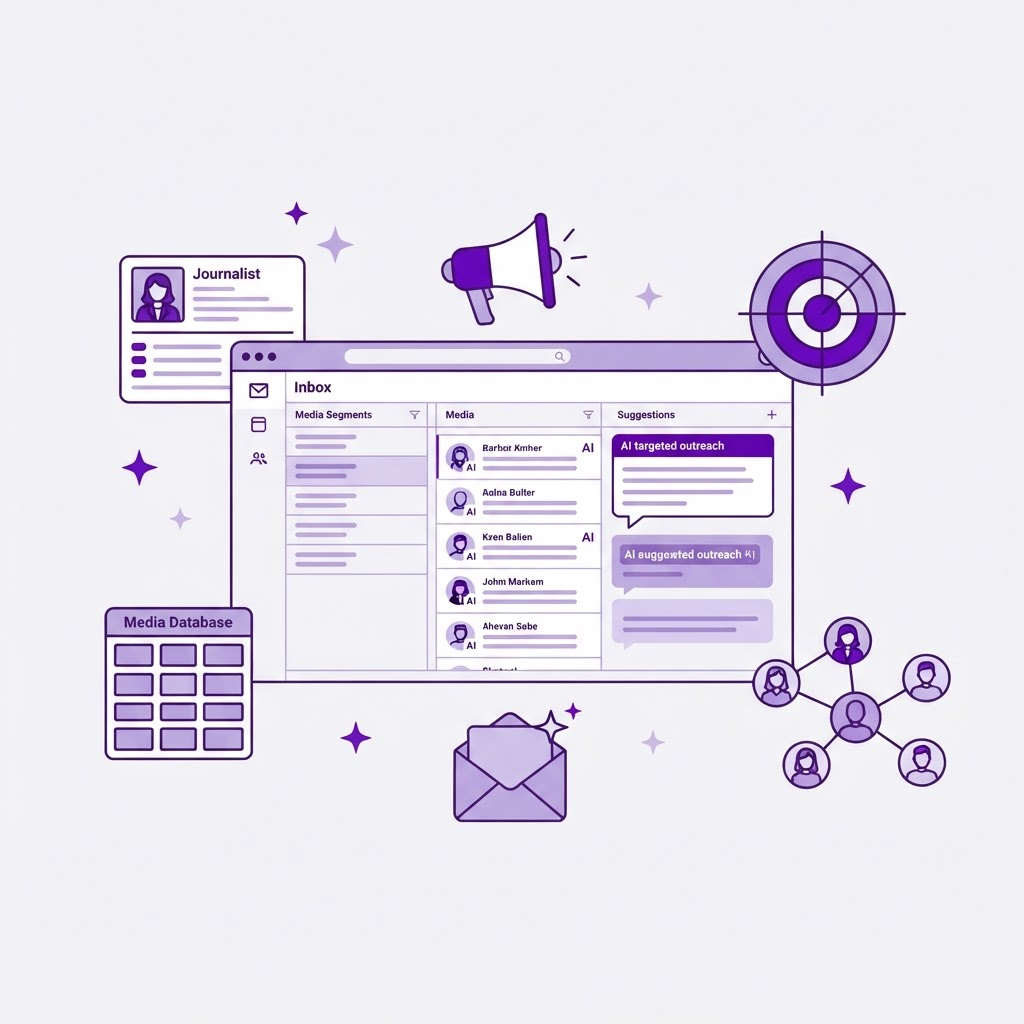
Media databases such as Cision, Muck Rack, and Roxhill are adding AI features - Cision, for example, suggests additional contacts just before you hit send.
These built-in suggestions are useful, but they have a structural limitation: they work from the database's own tagging and past coverage data, and they optimise for adding more names to the send list.
Running your own AI tools alongside the database - Claude, ChatGPT, or similar - is often more powerful, for three reasons.
First, you control the prompt, which means you can ask strategic questions ("which categories of journalist should see this?") rather than accepting one-click additions.
Second, you can feed it your actual release and get reasoning back - why a sector fits, what angle works for it - rather than just names.
Third, your own AI can generate the tailored materials (intro paragraphs, subject lines, angle variations) that the database's suggestion engine doesn't produce.
The workflow that works: use AI to define the categories and the angles, then use the database to find the actual humans in those categories, then use AI again to tailor the approach for each segment.
What prompts should I use to identify journalist categories?
Before opening your media database, paste your release into your AI tool with a prompt like this:
"Here is my press release: [PASTE RELEASE]. What categories of journalist should I be looking to send this to? For each category, explain what angle in this release would interest them, rank the categories by likely interest, and flag any category where the story is probably too weak to pitch."
The ranking and the "too weak" flag matter - they stop you spraying the release at sectors where it will only train spam filters.
Follow up with a search-term prompt to bridge into your database:
"For each of those categories, give me the search terms, beat names, and job titles I should use to find these journalists in a media database like Cision."
And a blind-spot check:
"What non-obvious journalist categories might care about this story that I haven't thought of - regional angles, trade verticals, or adjacent beats?"
That last prompt regularly surfaces the trade and regional angles that turn one story into five - a family-friendly finding becomes a parenting-press story, a survey with city-level data becomes twenty regional stories.
How do I use AI to customise the pitch for each segment?
This is where the real gains are, because segmentation without personalisation is just a smaller spray.
Once you know your categories, ask for a tailored opening for each:
"Here is my press release: [PASTE RELEASE]. Write a customised intro paragraph for this release aimed at [fintech trade journalists / regional news desks in the North West / parenting and family writers]. Lead with the angle that matters most to that audience, keep it under 60 words, and don't repeat the headline."
Then subject lines per segment:
"Write 5 subject line options for pitching this release to [category]. Under 9 words each, no clickbait, and lead with the finding rather than the company name."
And an angle-strength check before you send:
"You are a sceptical [category] journalist with 200 pitches in your inbox. Read this pitch intro and tell me honestly: would you open the release? What would make you delete it?"
Two rules keep this honest.
Customise by segment, not by individual - AI-generating "personal" lines about a specific journalist's recent articles reads as exactly what it is, and journalists increasingly call it out publicly.
And every tailored intro still gets a human read before sending, because AI will occasionally invent an angle the release doesn't actually support.
What does a full AI-assisted outreach workflow look like?
Putting it together, a release goes out in six steps.
One: paste the release into your AI tool and run the category prompt - get your ranked segments and the angle for each.
Two: run the search-term prompt and build your lists in your media database, one list per segment - not one master list.
Three: prune the lists by hand, removing anyone whose recent coverage clearly doesn't fit - the five minutes that protects your sender reputation.
Four: generate the tailored intro paragraph and subject lines for each segment, and edit them into your own voice.
Five: send segment by segment, ideally starting with the highest-ranked category - if the story lands there, you can reference early pickup when approaching the next tier.
Six: put the announcement version on the wire separately, for the record and your search results - distribution and pitching are different jobs, and mixing the lists ruins both.
What should AI never do in outreach?
In addition to the useful applications, there are hard lines worth drawing:
Sending without review
Fully automated AI outreach - generate, personalise, send - is how you end up on journalist blocklists, and it's the behaviour currently destroying trust in PR email as a channel.
Fake familiarity
AI-written lines like "I loved your recent piece on X" - when nobody loved anything - are the fastest way to burn a contact permanently.
If you haven't read their work, don't claim to have; a sharp, relevant, honest pitch beats a fake-warm one.
Inventing facts to strengthen a pitch
AI will happily "improve" an angle by exaggerating a statistic or implying a finding your data doesn't support - and a journalist who catches one invented number will never open your emails again.
Replacing the relationship
The follow-up call, the exclusive offered to the right person, the quote turned around in twenty minutes when a journalist is on deadline - the parts of outreach that build a career's worth of contacts cannot be delegated, and the time AI saves you elsewhere is best spent exactly here.
How do I measure whether AI is improving my outreach?
The honest metrics are the ones journalists control: open rates by segment, reply rates, and above all coverage secured per hundred emails sent.
If AI segmentation is working, you should see fewer total emails sent per campaign with more coverage per email - the opposite pattern, more volume for flat results, means the tools are being used to spray faster rather than aim better.
It's a good idea to run the comparison deliberately for a quarter: segment-and-tailor half your campaigns the AI-assisted way, run the rest as before, and let the coverage-per-email numbers decide.
How can I learn more?
For the drafting side of the workflow, see our guide on how to write a press release using AI, which covers prompt structure, fact-checking AI output, and the human elements a release still needs.
You can also explore the Digital24 Help and Support centre for guidance on preparing releases for distribution, or read about why we separate genuine editorial from syndication.
Disclaimer: We make reasonable efforts to keep the content of this article up to date, but we do not guarantee or warrant (implied or otherwise) that it is current, accurate or complete. This article is intended for general information purposes only and does not constitute advice of any kind, including legal, financial, or other professional advice. You should always seek professional or specialist advice or support before doing anything on the basis of the content of this article.
Written by
Sam Allcock
— Founder, Digital24Sam Allcock is the founder of Digital24 and a vastly experienced digital marketer specialising in digital PR, SEO, and online reputation management. He helps Fintech, Crypto and Tech founders own their search results through strategic media placements, newswire distribution, and guaranteed coverage on high-authority outlets. With over two decades in digital marketing, Sam has built and led multiple agencies and PR platforms, and his commentary has appeared in HuffPost, MSN, Business 2 Community, and a wide range of trade and consumer publications.
Put these PR techniques to work with targeted journalist outreach from our team.
Explore Journalist Outreach